The typical bathroom we remodel in Rego Park, Forest Hills or Ridgewood is five feet by eight feet, sometimes less. In a room that size the tile is the design. It is also most of the labor. Here is how the three choices we are asked about most compare in a small space, and what we have learned installing each of them.
Large-format porcelain
Anything with one side over 15 inches counts as large-format. In small bathrooms the common sizes are 12 by 24 and 24 by 48 inches, often in a marble look or a soft concrete look.
Why people choose it. Fewer grout lines, so the room reads bigger and cleaner. Easier to keep clean. A marble look without the sealing and staining of real marble.
What it demands. A flat substrate. Large tiles show every hump in the wall or floor as lippage, where one edge sits higher than the next. In pre-war Queens co-ops the walls are rarely flat, so the budget for prep is real. We use a leveling system during setting and a good quality thinset with full coverage. Cutting large-format porcelain around a toilet flange and a tub takes skill and a proper saw.
Layout matters. On a 5 by 8 floor, a 12 by 24 tile laid in a one-third offset along the long wall stretches the room. A stacked layout, with tiles aligned in a grid, looks modern and wastes less tile. Avoid a 50 percent brick offset with large tiles; it exaggerates lippage.
Cost. Mid-range material, higher install cost than standard tile because of the prep and setting time.
Mosaics
Small tiles on mesh sheets: 2 by 2 penny rounds, hexagons, 1 by 1 glass, elongated subway. In a small room they belong in two places.
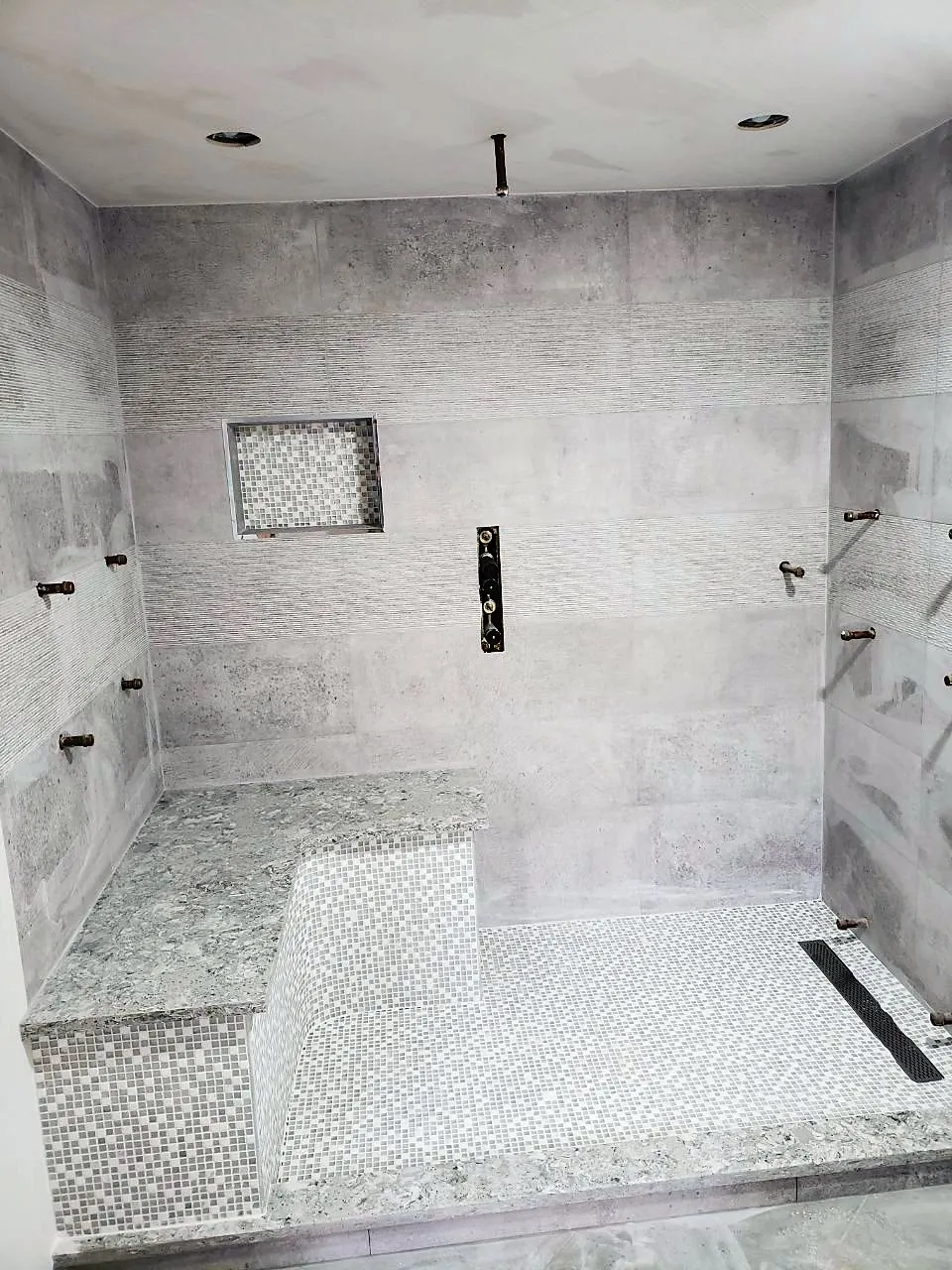
The shower floor. Mosaics follow the slope to the drain and give grip. Almost every shower floor we build is a mosaic unless the design calls for a linear drain.
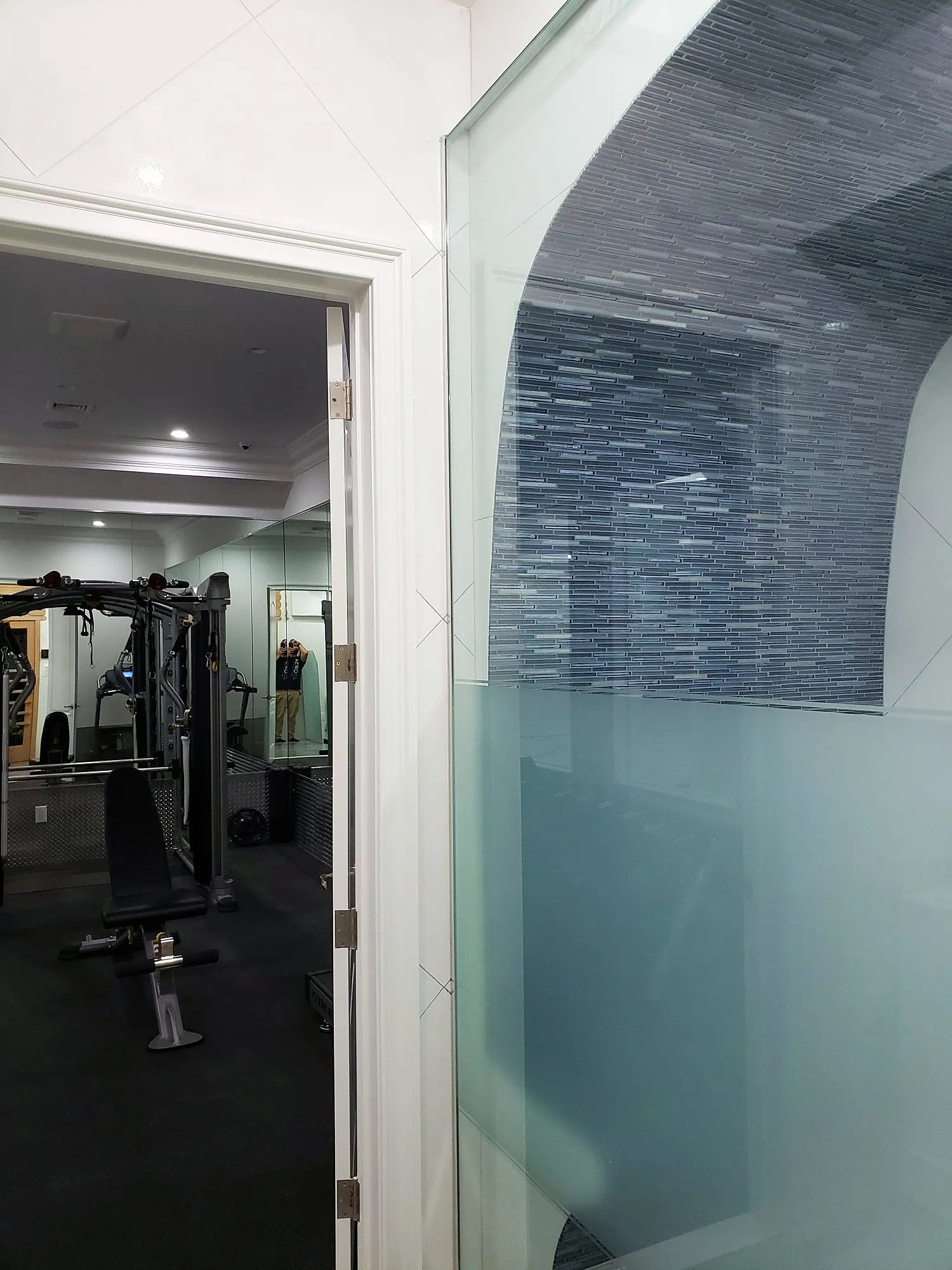
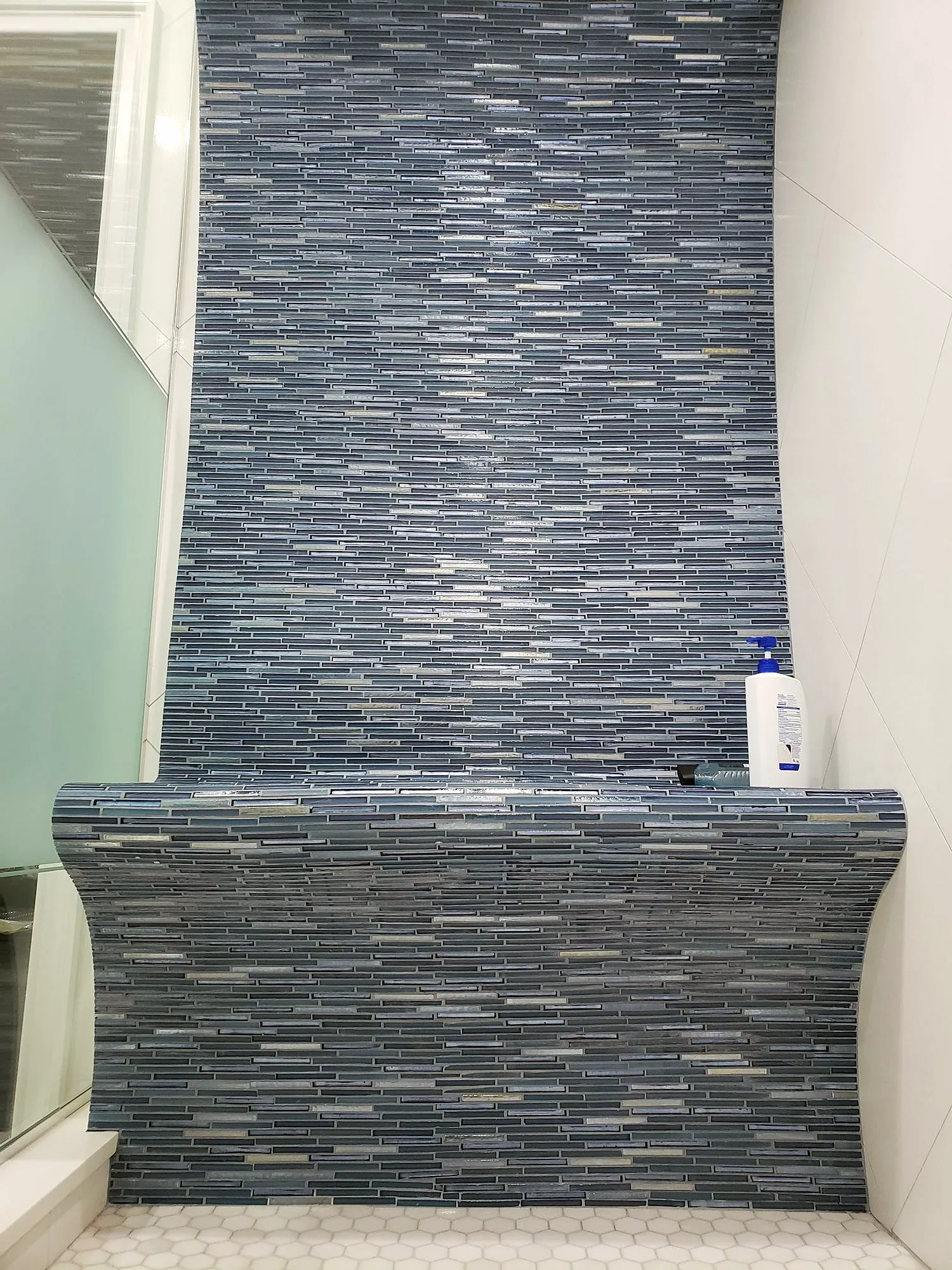
One feature surface. A single wall of blue glass mosaic behind the vanity or in the shower niche adds color without tiling the whole room in small pieces. The blue glass feature wall in one of our basement bathrooms is exactly this: one curved surface, everything else large white tile.
What to avoid. Mosaics on every wall of a small room. The grout lines multiply, the room feels busier and smaller, and the cleaning never ends.
Cost. Material ranges from cheap ceramic to expensive glass and stone. Install cost per square foot is higher than large-format because of the time, which is why we use it in small doses.
Wood-look porcelain
Planks, usually 6 or 8 inches wide by 24 to 48 inches long, printed to look like oak, walnut or weathered grey wood.
Why people choose it. Warmth in a room that is otherwise white and hard. It hides water spots. It runs well from a bathroom into a hallway in an open plan, as it did in the wood-look bathroom in our portfolio, where the same plank continued onto the walls and up to the sauna door.
What it demands. Planks are long and slightly bowed from the kiln, so a 50 percent offset puts the high center of one plank next to the low end of the next and creates lippage. Use a one-third or random offset. Planks also need a flat floor; the same prep rules as large-format apply.
On the walls. Vertical wood-look planks in a shower look striking. Horizontal is more common. Either way, plan the layout so cut pieces land where they are least visible.
Cost. Similar to large-format; the setting rules are the same.
Grout and trim, the details that decide the look
- Grout color. Matching grout to the tile hides the lines and enlarges the room. Contrasting grout highlights the pattern and shrinks it. In a small bathroom, match.
- Grout type. We use high-performance cement grout or epoxy in showers. Epoxy resists staining and never needs sealing, but it costs more and must be installed quickly and correctly.
- Edges. Metal profile strips give a clean edge on niches and outside corners and cost less than bullnose tile, which many large-format lines do not offer.
- Niches and benches. Line a niche in the same tile as the wall, with a solid-surface shelf that slopes to drain. A bench gets the large tile on top, mosaics below if you like, and waterproofing under all of it.
What we see fail
- Wall tile, often polished, used on a floor. Slippery when wet.
- Large-format tile over an unflattened wall. Lippage you can feel with a bare foot.
- Natural stone in a shower that nobody seals. Stains inside a year.
- Mosaic on five surfaces in a 40 square foot room.
- The tile ordered without extra. Order 10 to 15 percent over for cuts and for a repair box in the closet.
Picking for your room
If you want one answer: large-format porcelain on the walls and floor in a light color, a 2 inch mosaic on the shower floor, matching grout, and one surface, if any, with a feature tile. It is what we would do in our own five-by-eight.
Bring us photos of the tile you like and we will tell you how it behaves in your room, what the walls need before it goes on, and what each option changes in the estimate.